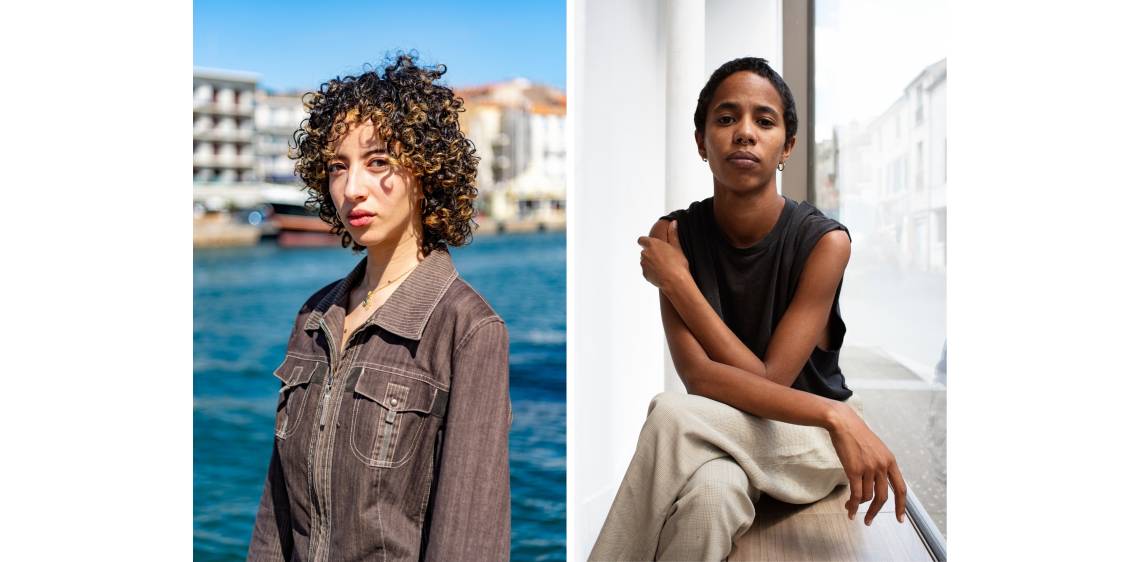
NESRINE SALEM
Nesrine Salem is a visual artist, author and researcher. Through her written and visual polyglossia, she celebrates the plurality of her identity and conducts research on intergenerational trauma, tokenism, and mourning practices. These subjects come together in her short film, What is the residue left from setting a black puddle on fire? (2023). At Triangle-Astérides, she launched SABR/Collection (2024), a series of publications edited by @postfirebooks that aims to highlight the intersectionality of struggles, which she curates. She presented her first institutional solo show “Comme convenu” (2025) at Galerie Édouard Manet. Laureate of Prix Occitanie-Médicis, she finished a residency at Villa Medici and is preparing for her next solo show at Crac, Sète (2026).
FANNY SOUADE SOW
Fanny Souade Sow is a sculptor and author, living and working in Marseille
Her work is imbued with socio-political and historical questions, and her pieces reflect systemic and violent mechanisms of oppression while contributing to the writing of a collective memory.
Her works have been shown in group exhibitions at KADIST (Paris), the Eric Dupont Gallery (Paris), the 66th Salon de Montrouge, La Graineterie (Houilles), and Triangle-Astérides (Marseille), among others. She has been a resident at the SAW Gallery (Ottawa, Canada), CAC Brétigny, and Glasgow Sculpture Studios (Glasgow, Scotland), and is currently a resident at the Marseille City Workshops 2024-2026. In 2024, she was the winner of the 15th Biennale de la jeune création at La Graineterie, the art center of the city of Houilles, and published her first collection, Trois dattes et une dent, in the SABR collection of Postfiresbooks. In 2025, she presented her first institutional solo exhibition at La Graineterie, and her work was acquired by the FRAC Ile-de-France collections.
RESIDENCY
This residency will be an opportunity for the duo to confront their narratives with the Brussels context, its obvious features and its blind spots: from multilingual work, one imperial language to others, to reflections on the segregation of European cities, which run through the work of Nesrine Salem and that of Fanny Souade Sow. It will serve as a laboratory for observing the effects of transplanting from one place to another, their performance addressed to art agents when these narratives, conceived within and for the African diaspora in Europe, are relocated.